Do I want or need an ADHD identity?
2 days ago


 The concluding remarks of Maurice Kay LJ in the Sharon Shoesmith case (see previous post) compare her case with that of Rose Gibb (see Court of Appeal judgement in that case). Shoesmith's problem was a report by Ofsted, whereas Gibb had to deal with a report on the superbug, C. difficile, by the Heathcare Commission. As far as the learned judge was concerned, in both cases it seemed "that the making of a public sacrifice to deflect press and public obloquy .... remains an accepted expedient of public administration in this country".


 Two front page articles in the Guardian this week emphasise the government's committment to social enterprise in the NHS. The first emphasised the principle of common ownership, as in John Lewis-style cooperatives. The second made clear that GP consortia will go ahead despite all the opposition.
  A Department of Health press release says that a "review of the National Programme for IT (NPfIT) has concluded that a centralised, national approach is no longer required". But where is this review? There's no link in the press release, as one might expect. There's no explanation on the Connecting for Health website, beyond a reference to this press release.
 Chris Ham in a BMJ article Why the plans to reform the NHS may never be implemented points out the uncertainty about whether the Coalition government's NHS White Paper will be implemented. It's not clear how negotiations with the BMA will go. GP consortia may not be that much different from PCTs. I also suspect that Payment by Results will introduce too much instability and distortion of priorities for it to be implemented without more controls. Consultation on the proposals closes next month.
 Mike Brearley in the Observer points out that Kevin Pietersen needs his confidence boosting. England have just beaten Pakistan (see Guardian report, who beat Australia in England (again, see Guardian report). England are likely to need Pietersen in good form to beat Australia in Australia.
 As Chris Ham says in his BMJ editorial, Andrew Lansley came into government with a plan for the NHS. This has moved on rapidly from the Tory manifesto. The encouragement of the enterprise culture is welcome, but the implications are unclear.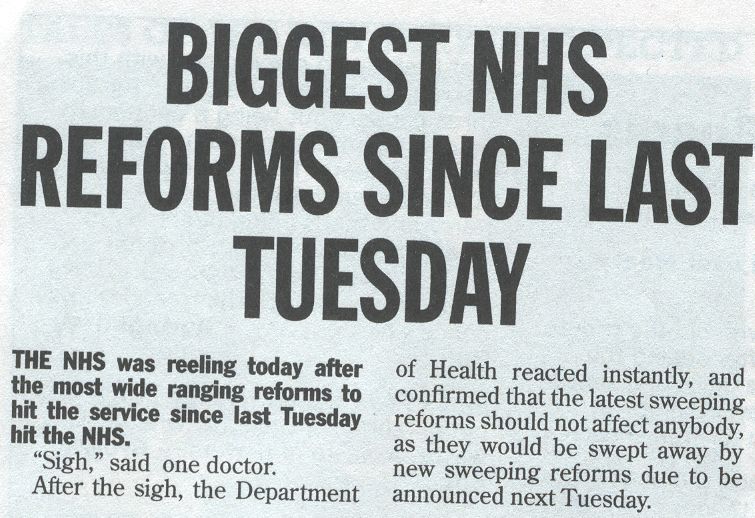
 I hope the The Independent Police Complaints Commission judgement about the individual police officers in the Kirk Reid case does not have the same pompous disdain as Kathy Lette writes about. Isn't the problem us, society and the police, rather than three individuals?
 Liam Fox's interview in The Times quotes him as saying "We are not in Afghanistan for the sake of the education policy in a broken 13th-century country". I think he must be meaning that the war isn't about the Taliban banning education for women and making the madrassa the main source of education. I presume he doesn't mean that Islam is not a 21st century religion.
 In a previous post, I said we needed independent academic opinion to publish comment on the use of hospital mortality data to justify the investigation into Mid Staffordshire NHS Foundation Trust (also see another previous post). The recent BMJ editorial by Nick Black is pertinent.
 PACA press release. Why is it that the GMC gets these sort of matters wrong? Doctors need to have trust in the GMC that it will not make defensive risk averse decisions. I have always supported David Southall (see previous post and letter to THES).
 Guardian obituary of David Clark. His book Social therapy in psychiatry influenced me. I also trained at Fulbourn Hospital, although Clark had just retired before I started as a junior psychiatrist there. His history of Fulbourn Hospital (The story of a mental hospital) is of interest.
It's important the history of the therapeutic movement in psychiatry is not forgotten. A major advance in psychiatric care was the opening of the doors of the traditional asylum. Unfortunately, to some extent, there has been a reinstitutionalisation of psychiatric care and sometimes the worst excesses of the asylum are now repeated in the community. Risk averse policies and interventions can actually cause problems for patients in terms of their rehabilitation and recovery.
Guardian obituary of David Clark. His book Social therapy in psychiatry influenced me. I also trained at Fulbourn Hospital, although Clark had just retired before I started as a junior psychiatrist there. His history of Fulbourn Hospital (The story of a mental hospital) is of interest.
It's important the history of the therapeutic movement in psychiatry is not forgotten. A major advance in psychiatric care was the opening of the doors of the traditional asylum. Unfortunately, to some extent, there has been a reinstitutionalisation of psychiatric care and sometimes the worst excesses of the asylum are now repeated in the community. Risk averse policies and interventions can actually cause problems for patients in terms of their rehabilitation and recovery.
 Chris Ham's BMJ editorial describes the situation in the NHS that the next government needs to improve:-
 Remarkable successes of John Hendy, QC, to obtain an injunction twice in the case of Gillian Mezey: firstly in September 2006 to bar her employing NHS Trust from suspending her from non-clinical duties; and secondly in December 2008 to restrain the Trust from taking disciplinary action. The court of appeal has recently upheld the second injunction (see BMJ story and court judgment).
 Blair's case at the Chilcot inquiry was that intervention in Iraq had saved us from the more dangerous threat we would now face from a richer and more defiant Saddam Hussein. His beliefs behind his foreign policy are said to be set out in his Chicago 1999 speech (large sections of which were written by Sir Lawrence Freedman, a member of the Chilcot panel).
  The latest NHS 5 year plan NHS 2010-2015: From good to great. Preventative, people-centred, productive is written in the context of the Chief Secretary to the Treasury's document Putting the frontline first: Smarter government. The plan confirms the need for £15 - 20 billion in so-called efficiency savings over the three-year period from April 2011.
 Dr Foster believes itself to be the leading provider of comparative information on health and social care services. It's latest hospital guide has caused controversy.
  Why's Baroness Young leaving the Care Quality Commission (CQC)? As CQC says on its website she resigned on 26th November. It can't be a coincidence that this was the day before the regulators demanded improvement at Basildon and Thurrock University Hospitals NHS Foundation Trust. It's also true that she has been a breath of fresh air in NHS regulation and to my mind a sad loss.
 More on better direction for NHS (see earlier post). Mike O'Brien, health minister, has described the kind of NHS manager that will be named and shamed (see HSJ article):
  The theme of a "call for evidence" by the Local Government Association (LGA) is liberating local public sector partners to serve local people rather than serving the machinery of Government.
  Speech by health secretary to King's Fund spells out that the NHS for a fourth-term Labour government will be "preventative and people-centred, placing quality at the heart of all that it does". He also made clear that the NHS is moving on from top-down reform. "It led to a feeling that reform was imposed; done to people, rather than with them. It gave unintended messages at ward level – ‘public bad, private good’ – and process targets implied a lack of trust." He also recognised that "there is a danger that people in the service try to read the runes and conduct their own mini spending reviews".
 Article in Student BMJ about medical professionalism. It notes how professionalism is viewed differently by doctors, nurses and patients. A conscientiousness index has been proposed as a measure of professional behaviour in medical students.
 Norman Lamb, MP for North Norfolk, has written about the Cawston Park fiasco (see my previous post) in Mail Online. I agree that it is important to get to the bottom of what happened to Andrew Breeze and Dominic Wilson. I still think there must have been envy (or similar) motivating the criminal prosecution. The background national scandal of shipping difficult to manage and place psychiatric patients out of the NHS into expensive private care barely figures in public statements about central NHS mental health policy thinking.
 Observer story about Father and Sun highlights how James Murdoch, Rupert's son, is steering the Sun, together with Rebecca Brooks, previous editor, and now CEO of News International.
 The Sun says it's bloody shameful that the Prime Minister doesn't know how to spell his own name. Instead of putting Gordon, he's put Gorm. Instead of putting Brown, he's put Bum.
  We do expect a Prime Minister to be able to dot the i's. And he shouldn't have to repeat the word "sincere".
 If you do say you feel let down by psychiatric inpatient care, you might incur the wrath of Louis Appleby, the Mental Health Tsar. Thank goodness the Care Quality Commission (CQC) is independent of government, because Appleby thinks they've "deliberately distorted" the results of a survey of mental health acute inpatients (see Community Care news). At least Kay Sheldon, one of the CQC Board, who has herself been detained under the Mental Health Act and received a payout from the NHS for wrongful diagnosis of schizophrenia, has answered him (see blog).
 Sorry to see the Times obituary for Austin Gresham, who was my Professor of Morbid Anatomy and Histopathology when I was a clinical medical student in Cambridge. I was hopeless at pathology, but I turned up fairly regularly for the 1.30pm meetings in the dissection room when the results of postmortem examinations were presented. Gresham's morbid interest in pathology fascinated me, as did his gruesome particular interest in forensic cases.